Wall Spray Foam Insulation
Fiberglass batts fill wall cavities but leave gaps at every stud, outlet, and top plate for cold air to find. Spray foam seals and insulates the wall assembly in one application, cutting drafts and helping Pinetop-Lakeside homes hit a genuine cold-climate wall target.
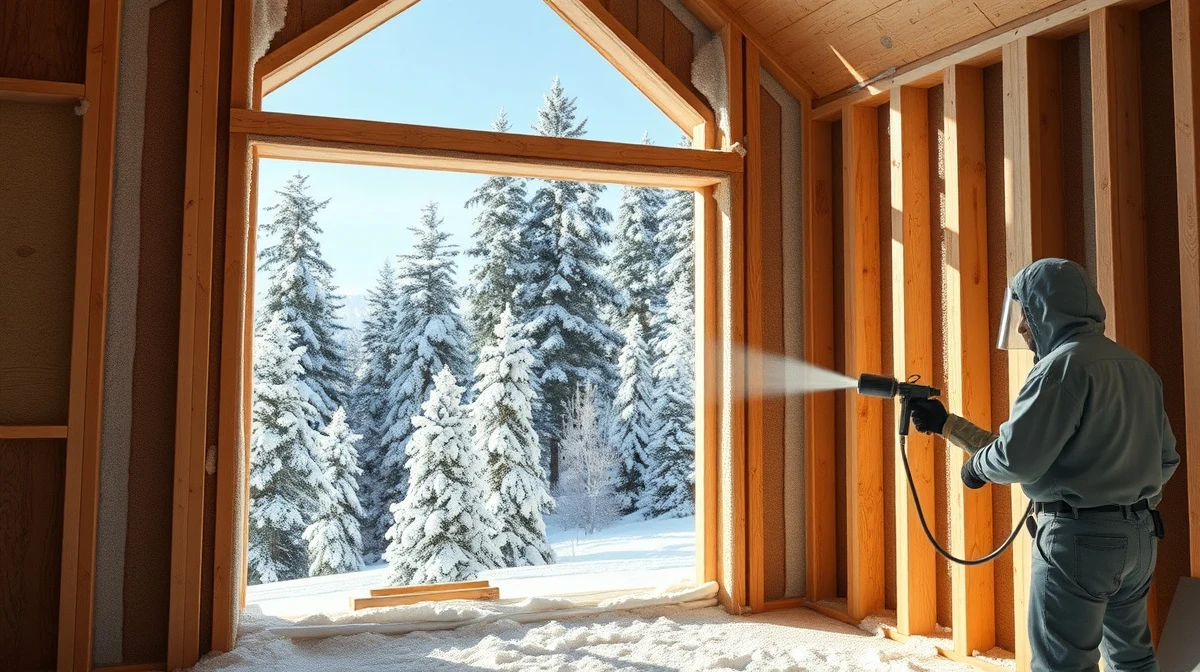
At roughly 6,800 to 7,200 feet, wind-driven cold doesn't politely wait at the exterior siding — it works its way through every stud bay, electrical box, and top-plate gap that a batt of fiberglass was never designed to seal. White Mountains winters bring sustained sub-freezing stretches that push cold air straight through a wall assembly with any air gaps at all, and fiberglass batts, by design, rely on friction-fit alone. Once a batt settles, gets compressed around wiring, or gets cut short around a window rough opening, the R-value on paper stops matching the R-value in the wall. Homeowners feel this as a cold wall surface, a draft near outlets and switch plates, or a living room that never quite holds heat even with the furnace running.
Spray foam changes the equation because it insulates and air-seals in a single application, expanding into every irregular gap, stud cavity, and penetration as it cures. That matters more in a genuine cold-climate zone like Pinetop-Lakeside's IECC 5B than it does in milder parts of the state, because a properly built high-country wall assembly should carry substantially more R-value and a tighter air seal than a statewide desert minimum. We install closed-cell or open-cell foam sized to hit a strong wall target and stop the infiltration path, not just add material to the cavity.
Why homeowners choose it
- Air-seals and insulates the wall cavity in one application, closing the gaps fiberglass batts leave at studs, outlets, and top plates.
- Helps the wall assembly meet a genuine cold-climate target rather than a desert-oriented statewide minimum.
- Reduces cold-wall surface temperature and the draft you feel standing near an exterior wall on a windy winter night.
- Closed-cell foam adds rigidity to the wall assembly, a real consideration where wind and seasonal snow-load stress accumulate over a White Mountains winter.
- Cuts the workload on your furnace or heat pump by reducing conditioned-air loss through infiltration, not just conduction.
- Performs consistently over time — spray foam doesn't sag, settle, or compress the way batt insulation does inside a wall cavity.
Why Wall Air-Sealing Matters More at This Elevation
Pinetop-Lakeside's elevation and forested exposure mean wind-driven infiltration is a bigger factor in wall heat loss than it is in milder climates. A fiberglass batt can technically carry an R-13 or R-21 rating and still perform far below that number once it's compressed around wiring, gapped at a window header, or simply not cut tight to the stud on both sides. Air movement through those gaps carries heat out of the house far faster than conduction through the insulation material itself — which is why a wall can feel cold to the touch even when the cavity is nominally insulated.
A cold-climate wall assembly should account for both cavity R-value and continuous exterior insulation where the framing allows it, because continuous insulation is the only way to interrupt thermal bridging through the studs themselves — the wood framing members that batts can't cover. Spray foam applied in the cavity, paired with continuous exterior insulation where the assembly calls for it, is a direct answer to how a Pinetop-Lakeside winter actually attacks a wall.
- A tighter air-leakage standard is appropriate at this elevation than in lower-desert Arizona construction
- Wall target: roughly R-20 or better, with continuous insulation where framing allows
- Continuous insulation breaks thermal bridging through wall studs that cavity-only batts can't address
Open-Cell vs. Closed-Cell for Wall Cavities
Both foam types air-seal effectively, but they solve slightly different problems in a wall assembly. Open-cell foam (roughly R-3.5 to R-3.7 per inch) fills a standard 2x4 or 2x6 cavity fully and is a strong, cost-effective air-seal and sound-dampening choice for interior partition walls and many exterior applications where cavity depth is sufficient to hit a solid R-value target on its own.
Closed-cell foam (roughly R-6 to R-7 per inch) delivers close to double the R-value per inch, which matters in a 2x4 wall where framing depth is limited and every inch counts toward a strong overall target. Closed-cell also adds rigidity to the wall assembly and resists moisture intrusion better, both relevant considerations where wind and seasonal snow-load stress build up on exterior walls over a Pinetop-Lakeside winter. We'll walk you through which makes sense for your specific wall depth and assembly during the on-site assessment.
- Open-cell: ~R-3.5-3.7 per inch, strong air-seal and sound-dampening for standard cavity depths
- Closed-cell: ~R-6-7 per inch, best for limited framing depth and added structural rigidity
- Fiberglass batts run ~R-2.9-3.8 per inch in real-world conditions after air gaps and settling
What to Expect from a Wall Foam Project
Wall spray foam is most straightforward when cavities are open and accessible — new construction, additions, gut remodels, or any project where drywall hasn't gone up yet or has already been removed. We assess your specific wall assembly, framing depth, and target R-value on-site, then apply foam sized to hit a strong assembly target rather than just filling the cavity with whatever fits.
For existing finished walls, options are more limited but not off the table — injection foam and targeted access points can address specific problem areas like a consistently cold room or a known draft source. We'll tell you honestly during the assessment whether your situation calls for a full cavity approach, an injection approach, or whether the issue is better solved elsewhere, like an attic or crawl space gap letting cold air migrate into the wall system.
Ideal for
- Homeowners with noticeably cold exterior walls or drafts near outlets and switch plates in winter
- Remodels and additions where wall cavities are open and accessible before drywall goes up
- Older Pinetop-Lakeside homes and cabins originally built with minimal or settled fiberglass batt insulation
- Builders targeting a genuine cold-climate wall assembly on new construction or additions
- Anyone replacing siding or doing exterior work where wall cavities are briefly exposed from outside
What affects the cost
Wall Insulation questions, answered
Yes, through injection foam methods that access the cavity through small drilled holes, though full cavity spray during a remodel or addition gives more complete coverage. We'll assess your specific walls on-site and tell you honestly which approach fits your situation.
Fiberglass batts rely on a friction fit and don't seal air gaps at studs, outlets, or top plates, so cold air infiltrates around the material even when the cavity looks insulated. That air movement is usually the real source of a cold wall surface, and it's exactly what spray foam's air-sealing property is built to stop.
A strong cold-climate wall target here runs roughly R-20 or better, ideally with some continuous insulation on the exterior side of the framing to break thermal bridging through the studs. That's noticeably higher than a statewide minimum built around Phoenix-area desert construction.
It depends on your wall's framing depth and target R-value. Closed-cell delivers roughly double the R-value per inch, which matters in a standard 2x4 wall, while open-cell is a strong, cost-effective option in deeper 2x6 cavities. We'll recommend the right fit during your on-site assessment.
Yes — beyond reducing furnace or heat-pump load from infiltration losses, closed-cell foam adds rigidity to the wall assembly and improves moisture resistance, both relevant where wind and seasonal snow-load stress build up on exterior walls through a White Mountains winter.
Wall Insulation done right, by a local Pinetop-Lakeside crew
Wall Insulation isn't a commodity — the result depends entirely on how carefully it's planned and installed for your specific home or cabin and Pinetop-Lakeside's real high-country climate. We assess what your property actually needs, prep and air-seal properly, and install to your elevation-appropriate R-value target, so the work delivers the comfort and savings it's supposed to.
We serve Pinetop-Lakeside, Show Low, Linden, McNary, Hon-Dah/Whiteriver, Pinedale, Heber-Overgaard, Greer, and Eagar/Springerville. Every job starts with a free, no-pressure quote.
Just as important, we treat your home or cabin like the system it is. Insulation, air sealing, and ventilation all interact, and getting one right while ignoring the others leaves comfort and savings on the table. When we scope your wall insulation, we look at how it fits the whole picture — so the finished result performs the way it should, holds up through a genuine White Mountains winter, and actually lowers the bills you feel every month.
Free assessment
We evaluate your home or cabin and give you a clear, itemized quote.
Expert install
We prep, air seal, and install your wall insulation to spec — clean and on schedule.
Savings you can feel
A warmer home, lower heating bills, and honest advice about what your property needs.
Related services
Ready for a free wall insulation quote?
Tell us about your home and we'll put together a clear, no-pressure spray foam insulation quote — built for Pinetop-Lakeside's real winters.